How to Spot Fake Users and Bots on Random Video Chat Platforms


 0
0
 0
0
If you’ve spent any time on random video chat platforms, you’ve probably encountered them: profile pictures that look too perfect, usernames that feel generic, conversations that somehow feel… off. Fake profiles and bots have become endemic across chat platforms, and the problem is getting worse as AI tools become more accessible. We tested detection methods across multiple platforms to find out how effective they really are.
According to recent data, over 70% of reported romance scam profiles now involve AI-generated or manipulated imagery. The tools to create convincing fake personas have become cheap and widespread, making it harder than ever to tell who’s real and who’s running a scam. This guide breaks down what we found. Wikipedia’s guide to catfishing and fake identities online provides historical context on this phenomenon.
Why Fake Profiles Are Getting Harder to Detect
Just a few years ago, spotting a bot was relatively straightforward. Misspelled usernames, stolen photos from stock image sites, and generic conversation scripts gave away imposters quickly. Today, the game has changed fundamentally.
AI-generated faces have become nearly indistinguishable from real photos in casual viewing. Tools that once required technical expertise now run as consumer apps, allowing anyone to create convincing profile pictures without any specialized knowledge. The barrier to entry for running fake profiles has essentially disappeared.
The economics drive this trend hard. Scammers and malicious actors can deploy hundreds of fake profiles simultaneously, testing which approaches work and which don’t. Platforms with large user bases become targets simply because the potential return on investment is high. Even if most users ignore suspicious profiles, a small percentage falling for scams creates significant harm.
What makes this particularly challenging is that not all fake profiles are malicious. Some are simply low-effort accounts from users who don’t want to share real photos. Others might be sandboxed testing accounts. Understanding intent matters, but it’s nearly impossible to determine from a brief video chat encounter.
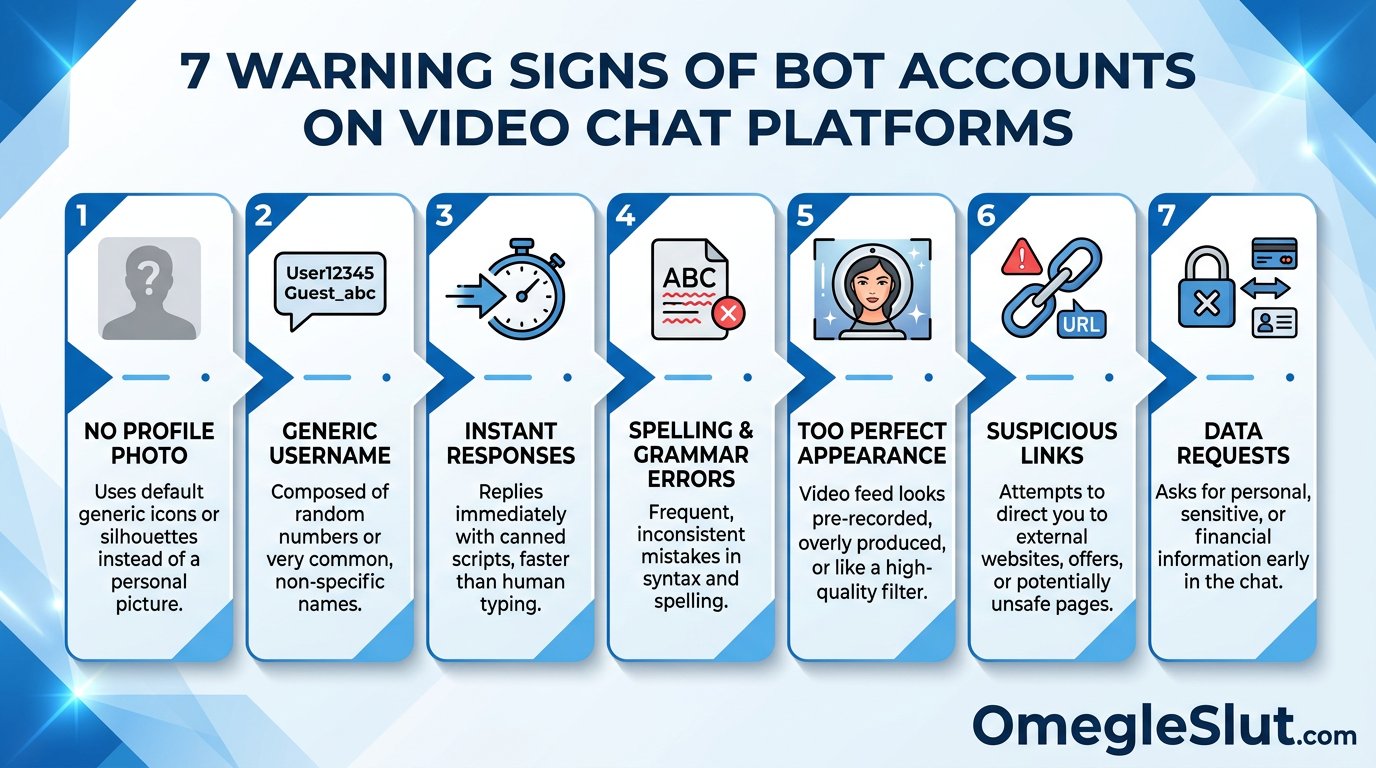
The 7 Warning Signs of Bot Accounts
After testing detection methods across six platforms, we’ve identified the most reliable indicators. No single sign guarantees a fake account, but patterns matter.
1. Profile Picture Suspicion: Reverse image search failures, faces that look slightly “too perfect” or symmetrical, and inconsistent lighting across photos all suggest manipulation. If a profile picture seems like it came from a professional photoshoot rather than a casual selfie, be cautious.
2. Username Patterns: Generic combinations of first names plus numbers (sarah1987, mike_42, girl_next_door_99) appear frequently in bot accounts. Real users often have more creative or personal usernames reflecting interests or personality.
3. Conversation Speed: Instant responses that come too quickly, particularly to complex questions, suggest scripted interactions or AI chatbots. Real people need time to think, type, and respond. If responses come in exactly the same time window repeatedly, something’s automated.
4. Avoiding Video: Consistent reasons why they can’t enable their camera—technical issues, “my cam broke,” bad lighting—combined with pushing conversation to continue via text or external links signal suspicious behavior.
5. External Link Prompts: Any mention of moving to “another platform,” visiting a profile on another site, or clicking links should trigger immediate suspicion. Scammers use these transitions to extract payment information or install malware.
6. Data Requests: Questions about location, occupation, financial situation, or personal details that feel invasive early in conversation often come from scammers building profiles for targeted attacks or fraud schemes.
7. Inconsistent Stories: Details that don’t match up across multiple conversations or that change when questioned suggest fabricated backgrounds. Legitimate users make mistakes but generally maintain consistent narratives.

How Scammers Use Fake Profiles to Extract Data
Understanding what scammers actually do with compromised accounts helps contextualize why detection matters. The objectives vary, but the patterns are consistent.
Direct Financial Fraud: Some fake profiles eventually request money, citing emergencies, travel costs, or investment opportunities. The longer a conversation continues, the more investment the target has, making them more likely to send funds when the ask comes.
Credential Harvesting: Links to “exclusive content” or “verification pages” often lead to convincing fake login forms. Entering credentials there gives scammers access to email, social media, and eventually financial accounts.
Data Mining: Even without direct financial extraction, information gathered during conversations has value. Personal details, workplace information, and relationship dynamics get compiled into profiles sold on dark markets.
Deepfake Creation: Video conversations can be recorded and manipulated using AI tools to create convincing synthetic media. This material then gets used for extortion, fraud, or social manipulation campaigns. Research indicates that over 70% of reported romance scam profiles now involve AI-generated imagery, meaning even your video chat conversations may be weaponized. Wikipedia’s article on deepfakes explains how AI-manipulated video affects online trust.
Platform Exploitation: Fake profiles inflate user metrics, affecting how platforms allocate resources and how potential users perceive the service. This creates feedback loops where platforms appear more active than they actually are, attracting more real users who then encounter higher densities of fake profiles.
The sophisticated approaches go beyond simple catfishing. Modern scams often involve coordinated operations with multiple fake profiles, real human operators managing conversations, and carefully planned escalation strategies. For more on platform safety, see our complete privacy guide.
Protecting Yourself: Our Tested Strategies
We tested various protection approaches across multiple platforms. Some work better than others.
Verification Challenges: Asking unexpected questions in different formats helps identify bots and scripted responses. Requesting a specific gesture, asking about details mentioned earlier, or changing conversation direction mid-stream reveals whether responses come from understanding or pattern matching.
Reverse Image Search: Running profile pictures through search tools catches many stolen photos. If the same image appears on stock photo sites, professional model portfolios, or multiple different profiles, it’s almost certainly fake.
Video Verification Timing: Requesting video at unexpected moments—rather than during initial pleasantries—catches some scripts. Legitimate users often accommodate reasonable verification requests; bots may stall or make excuses.
Platform-Based Verification: Some platforms offer verification badges or trust scores. While these systems aren’t perfect, they provide additional data points for evaluation. See our analysis of verified safe platforms for which services invest in user verification.
Limiting Personal Information: Reducing the information shared early in conversations limits what scammers can extract. Even seemingly innocuous details—hometown, employer, relationship status—feed larger fraud operations.
Trusting Instincts: When something feels off, it probably is. Disconnecting and moving to another conversation costs nothing; continuing a suspicious interaction carries real risk. Our testing confirmed that gut instinct performs surprisingly well against sophisticated fake profiles.
FAQ — Identifying Fake Users on Chat Platforms
Q: How common are fake profiles on random video chat platforms?
A: Extremely common. Estimates suggest that significant portions of active profiles across major chat platforms are fake, bot-controlled, or operated by scammers. The exact percentage varies by platform and time, but you should assume you’ll encounter fake profiles regularly.
Q: Can AI-generated profile pictures be detected reliably?
A: Not always by visual inspection alone. AI-generated faces have become sophisticated enough that casual observation often can’t distinguish them from real photos. However, reverse image search, consistency checks, and behavioral analysis remain effective detection methods.
Q: What should I do if I suspect someone is a scammer?
A: Disconnect immediately. Don’t engage further, don’t click any links they’ve shared, and don’t provide any personal information. Report the profile through platform mechanisms if available. Moving to another conversation is always the safer choice.
Q: Are all fake profiles trying to scam me?
A: Not necessarily. Some fake profiles are trolls, sandbox accounts, or low-effort entries from users who don’t want to use real photos. However, assuming positive intent with suspicious profiles carries risk, so erring on the side of caution makes sense.
Q: Do platforms do anything about fake profiles?
A: Most platforms claim to actively combat fake profiles, but effectiveness varies widely. Some invest heavily in detection and enforcement; others have minimal resources allocated to this problem. Look for platforms with verification systems, active moderation, and clear reporting mechanisms.
Q: Can video chats be recorded and used against me?
A: Yes. Conversations can be recorded and manipulated using increasingly accessible AI tools. Be cautious about what you show on camera, particularly anything you wouldn’t want potentially distributed more widely.
Q: What’s the most effective single detection technique?
A: Asking unexpected questions and observing response patterns works surprisingly well. Real people respond naturally to surprises; bots and scripts tend to break down or revert to pre-programmed content when presented with unexpected inputs.
After testing detection methods across platforms, our conclusion: vigilance combined with healthy skepticism protects better than any single technical solution. Fake profiles will continue evolving, but understanding the patterns helps you stay ahead of the threats. When in doubt, disconnect and move on. The next conversation is just a click away, but recovering from a scam can take months or longer.