How to Talk with People from Different Cultures in Random Chat


 0
0
 0
0
Random Chat Across Cultures: How to Avoid Misunderstandings
One of the best things about random chat is that the next person may be from somewhere completely different. You might share a language but not the same sense of humour, ideas about politeness or expectations about how quickly a conversation should become personal.
That difference can create a great conversation. It can also create an awkward moment in seconds. A short answer may look unfriendly when it actually means the person is translating. A pause may feel uncomfortable to you but perfectly normal to them. Even a harmless joke can lose its meaning across languages.
This guide is for adults using 18+ random-chat platforms. It focuses on respectful international conversations, not stereotypes. The goal is simple: stay curious, make your meaning clear and give the other person room to communicate in their own way.
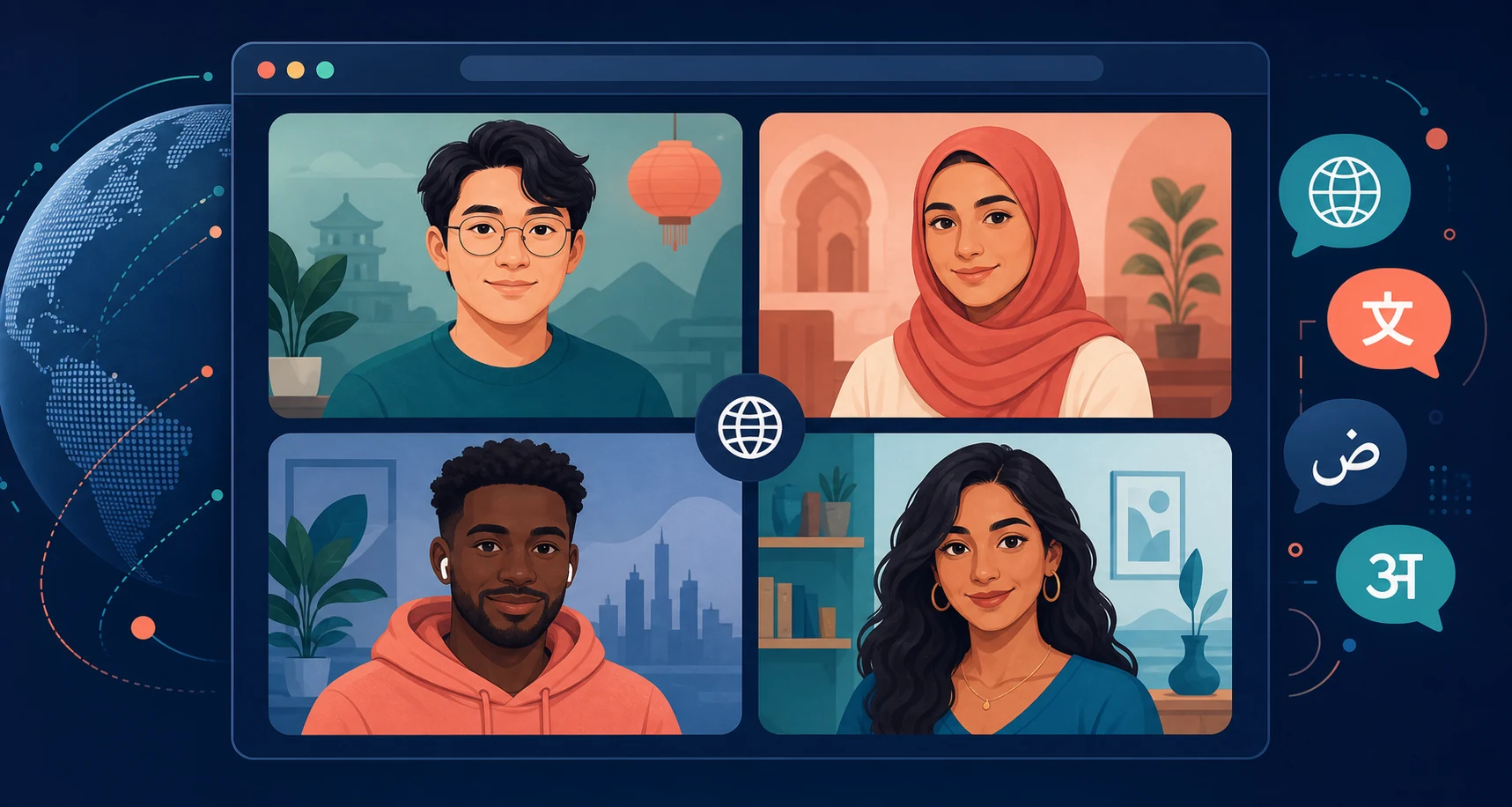
Why random chat across cultures can feel awkward so quickly
In a normal conversation, you pick up context from a person’s accent, surroundings, mutual friends and social setting. Random chat removes most of that information. You have a face, a voice, a few seconds of interaction and no reliable idea what the other person expects.
Online communication adds another layer. A gesture may be outside the camera frame. A smile may be nervous rather than amused. A delayed response may be caused by translation, connection quality or simply a different conversational rhythm.
The safest assumption is not that the other person is rude or uninterested. It is that you may not have enough context yet. Give the conversation one clarification before you decide what their behaviour means.
Readers who want a broader foundation can also review this guide on talking to strangers online safely. Cross-cultural awareness works best when it is combined with ordinary privacy and boundary habits.
How cultural context changes a first online conversation
Culture can influence how people greet, disagree, show enthusiasm, handle silence and decide what counts as a personal question. These are tendencies, not fixed rules. Two people from the same country can have completely different preferences.
Some people prefer direct questions and quick answers. Others build comfort through small talk before discussing opinions. Some use humour immediately. Others need time to understand whether a joke is friendly or critical.
Instead of trying to identify someone’s entire culture from one gesture, watch how the individual responds. Do they ask questions back? Do they answer in detail? Do they change the subject? Their actual behaviour in the moment is more useful than a generalisation about their nationality.
The British Council’s guidance on intercultural communication recommends adapting your communication style, looking for common ground and using open-ended questions. Those principles translate well to a short conversation with a stranger.
7 low-pressure questions that work across cultures
The best international conversation starters are easy to understand and open enough for the other person to choose the level of detail. Avoid questions that require local knowledge, private information or a perfect command of English.
- What is something you enjoy doing in your free time?
- What kind of music is popular where you live?
- What is a food from your region that you would recommend?
- What is the best place you have visited?
- What do people usually do for fun in your city or country?
- What is one everyday word from your language that you like?
- What topic could you talk about for a long time?
These questions invite a story without demanding an exact address, workplace or personal history. They also create natural opportunities to compare experiences: different meals, music, holidays, weather or ways of spending a weekend.
If a person answers briefly, do not assume they dislike the topic. Try one follow-up such as “What do you like about it?” or “Could you explain that word?” Then let them decide whether to continue.

How to use simple English when someone speaks another first language
Clear language is not childish language. It is a practical way to make a fast conversation easier for everyone. Use shorter sentences, familiar words and one question at a time.
- Say “Do you like films?” instead of “What are your cinematic preferences?”
- Say “I mean…” when you are explaining a phrase in a different way.
- Pause after a question so the other person has time to process it.
- Repeat the key idea rather than repeating every word at the same speed.
- Ask “What does that mean in your language?” instead of pretending you understood.
- Use a visual example only when it does not reveal private information.
Do not raise your voice simply because someone speaks another language. Speak clearly, not loudly. Avoid correcting every grammar mistake unless the person asks for language practice.
For people who prefer typing or need more time to translate, the existing guide to text-based stranger conversations offers a useful alternative format. A different pace does not mean a lower-quality connection.

Why sarcasm, slang and idioms cause fast misunderstandings
Native speakers often use expressions without noticing how strange they sound literally. Phrases such as “spill the beans,” “that’s sick” or “I’m pulling your leg” can be confusing when someone is learning English. Regional slang can be even harder to interpret because it may not appear in a standard dictionary.
Sarcasm is risky at the beginning of a conversation. It depends on tone, timing and shared cultural references. If the other person cannot tell whether you are serious, a joke can sound like criticism.
The University of Pittsburgh’s cross-cultural communication advice recommends avoiding idioms and slang, using short exchanges and checking that important points were understood. Its guide to communicating across cultures is especially relevant when English is not everyone’s first language.
You do not need to remove all personality from the conversation. Just introduce humour gradually. A simple, literal joke is easier to understand than a sarcastic comment about politics, religion or a sensitive social issue.
When silence, pauses and short answers mean different things
Silence is one of the easiest things to misread in a live conversation. One person may use a pause to think. Another may expect the other speaker to continue immediately. A short answer may mean “I am shy,” “I am translating,” “I am distracted” or “I want to change the subject.”
Give the person a moment before filling the gap. You can say, “Take your time,” or “We can switch topics if that is easier.” This removes pressure without making the pause feel like a problem.
Pay attention to patterns rather than one response. If the person keeps asking questions, they are probably still engaged. If they stop responding, look away repeatedly or use the next button, let the conversation end. Cultural awareness should not become an excuse to ignore a clear lack of interest.
Direct and indirect conversation styles compared
| Conversation moment | Direct approach | More indirect approach | Safer response |
|---|---|---|---|
| Changing the subject | “I don’t want to talk about that.” | A new question or a shorter answer. | Offer a different topic without demanding an explanation. |
| Disagreement | “I disagree.” | “Maybe there is another way to see it.” | Ask what they mean before defending your view. |
| Ending the chat | “I’m going now.” | A goodbye, pause or skip. | Accept the exit without taking it personally. |
| Showing interest | Many follow-up questions. | Listening and brief reactions. | Balance questions with space to answer. |
| Giving an opinion | Clear personal statement. | Story, example or suggestion. | Ask whether they want your opinion first. |
This table describes communication possibilities, not national personality types. Use it to stay flexible, not to label the person in front of you.
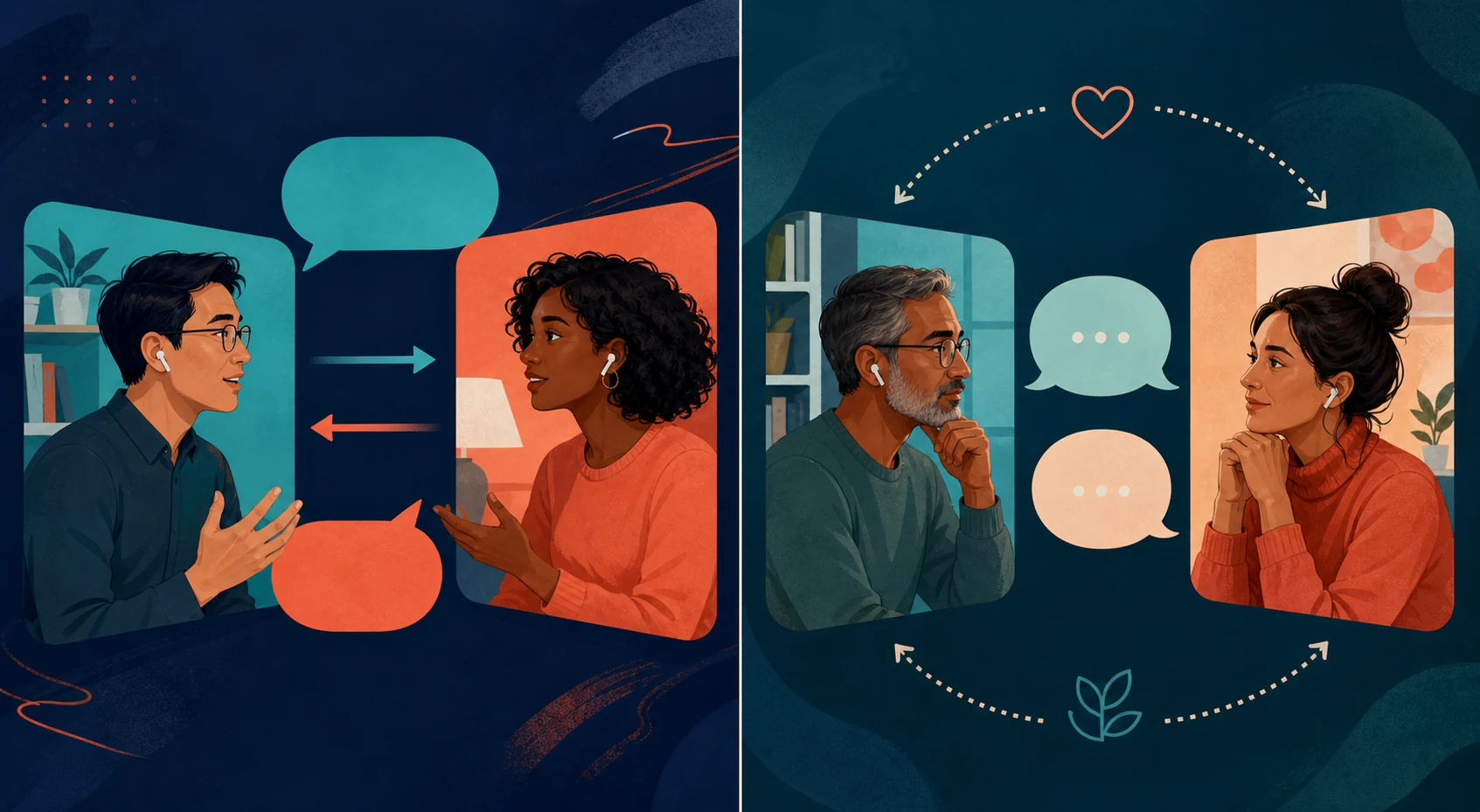
How to clarify a confusing message without embarrassing someone
Clarification is a sign of attention, not a criticism. A useful sentence is: “I want to make sure I understood you. Do you mean…?” It gives the other person a chance to correct the meaning without losing face.
You can also paraphrase: “So you mean that the tradition is important to your family, not that everyone follows it?” This is especially helpful when a word has more than one possible meaning.
Avoid saying “Your English is bad” or laughing at an accent. If you misunderstood, own your part: “I may have understood that incorrectly.” Mutual patience makes the conversation safer for both people.
Common mistakes when talking across cultures online
- Assuming a person’s nationality tells you how they think or behave.
- Using sarcasm before you understand the other person’s sense of humour.
- Speaking faster when someone asks you to repeat something.
- Correcting grammar when the person is trying to share an idea.
- Turning the conversation into an interrogation about stereotypes.
- Asking someone to represent an entire country, religion or region.
- Treating a quiet response as proof that the person is unfriendly.
- Using private location questions to test whether someone is “real.”
- Assuming that every gesture has the same meaning everywhere.
The biggest mistake is forgetting that cultural awareness is about understanding an individual more carefully, not replacing one assumption with another.
How to stay curious without turning culture into a stereotype
Ask about personal experience rather than making a statement about a whole group. “What is that like for you?” is better than “Do people from your country always do that?” The first question leaves room for individuality. The second suggests that one person must explain millions of people.
It is also fine to say that you do not know something. “I have never learned much about that tradition; would you like to tell me about it?” gives the other person control over the story.
Look for common ground without pretending differences do not exist. Music, food, pets, travel, sport, films and everyday routines can connect people quickly, while still leaving space to learn something new.
Is cross-cultural random chat worth trying for adults?
It can be, especially if you approach it as a conversation rather than a test. You may learn how another person sees an ordinary part of life, practise listening or discover a shared interest that would never appear in a profile-based service.
Keep normal safety rules in place. Do not share your exact location, workplace, private accounts, financial details or identity documents. A person being from another country does not automatically make them trustworthy or untrustworthy.
When a conversation becomes uncomfortable, use skip, block or report. The existing privacy guide for random-chat platforms covers the practical steps in more detail.
For better preparation before a session, readers can also continue to practical tips for stronger conversations. The best international interactions usually come from a simple combination: curiosity, patience and clear boundaries.
FAQ: talking with people from different cultures online
What is the safest first topic in an international random chat?
Start with neutral interests such as music, food, films, hobbies, travel or everyday routines. Let the other person decide how personal the conversation becomes.
How can I avoid offending someone from another culture?
Use clear language, avoid stereotypes and ask for clarification instead of guessing. If you make a mistake, acknowledge it and apologise briefly.
Should I research someone’s culture before talking to them?
Basic curiosity can help, but do not treat a country guide as a rulebook for an individual. Observe, ask respectfully and allow the person to describe their own experience.
What if we cannot understand each other?
Slow down, use shorter sentences, try text if available and choose a simpler topic. If communication remains difficult, end the conversation politely rather than forcing it.
Is it rude to leave after a cultural misunderstanding?
No. You can leave respectfully at any time. A misunderstanding is a reason to slow down, not an obligation to continue.